
Moelven Industrier ASA and the Moelven Group –Responsible Business Conduct and Supply Chain Transparency under the Transparency Act
The statement covers the period from January 1, 2025 to December 31, 2025.
The Moelven Group
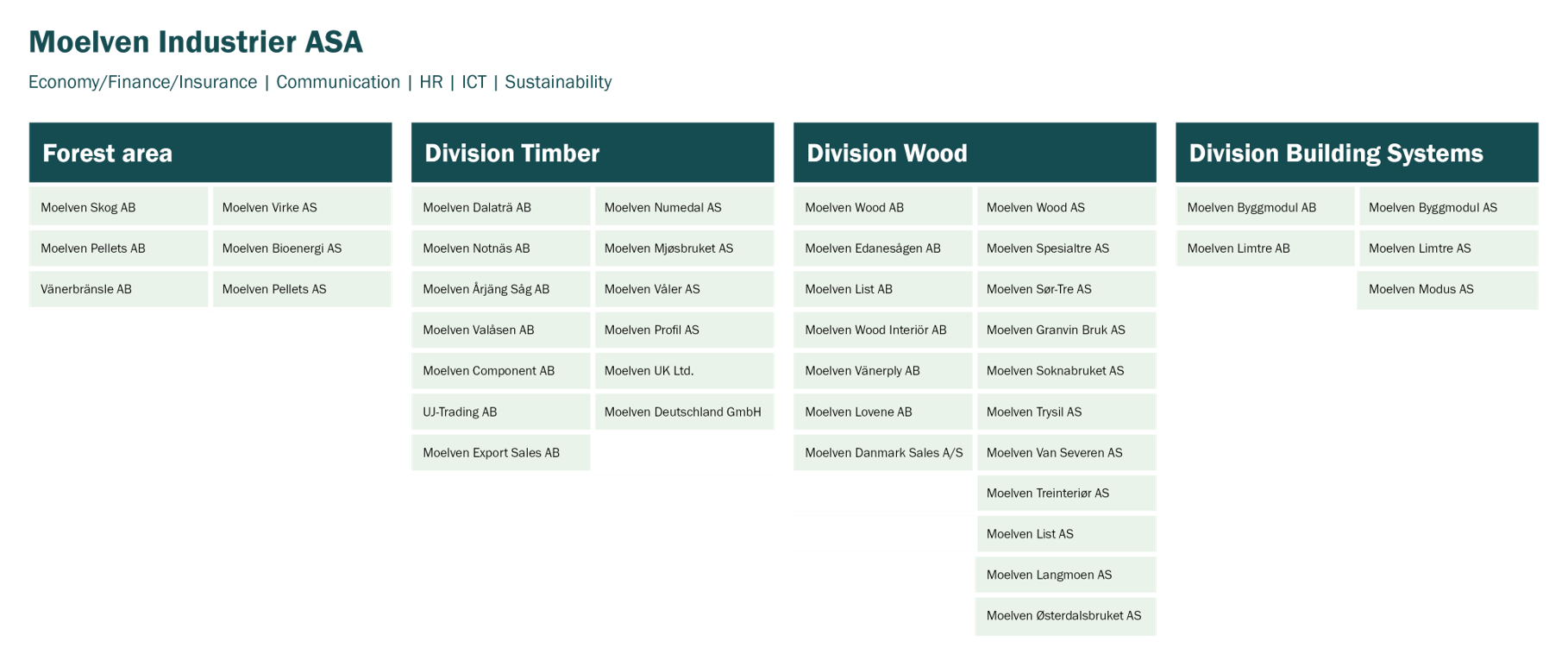
Moelven Industrier ASA is the parent company of the Moelven Group, a Scandinavian group with all production units located in Scandinavia, which is also its main market. Moelven Industrier ASA has its headquarters in Moelv, Ringsaker municipality. The group comprises 32 legal entities across 37 production sites and also has sales, service, and installation offices. Moelven offers a wide range of natural products and solutions, along with related services for new construction, renovation, reconstruction, and extensions of holiday properties, residential buildings, and commercial real estate (R&R). The Group also provides modular buildings, interior solutions, and load-bearing structures.
Furthermore, the Group delivers wood-based raw materials to the furniture, interior, and packaging industries. There is also significant activity related to the production and sale of wood pellets, wood chips, and biomass for bioenergy purposes, as well as for pulp, paper, and particleboard production.
The Group is organised into three divisions: Timber, Wood, and Building Systems, each focusing on its respective main segments: industry, trade, and projects. Additionally, there is a reporting segment called “Other,” which includes the holding companies with shared services, raw material procurement, production and sale of wood pellets and bioenergy, as well as the sale of chip and fibre products from the Group's timber processing operations.
Moelven’s value platform, which underpins the entire company’s operations, includes a responsibility for both people and the environment. A fundamental value for us is to keep our promises and build trust through collaboration and communication with our stakeholders. The Moelven Group’s Code of Conduct, Supplier Code of Conduct, and Sustainability Policy state that Moelven will work to ensure responsible business practices by safeguarding human and labour rights, society, and the environment in its own operations and throughout the value chain. We support and respect The UN Universal Declaration of Human Rights, The OECD Guidelines for Multinational Enterprises (OECD 2011), The International Labour Organization (ILO) Declaration on Fundamental Principles and Rights at Work, including freedom of association and the right to collective bargaining. We also expect our business partners to uphold these standards and do not accept any practices within suppliers’ or customers’ operations that violate the UN Universal Declaration of Human Rights, ILO standards, or Moelven’s Code of Conduct.
More detailed information about the Moelven Group and its subsidiaries is available here.
View signed company statements here (Norwegian only).
Moelven and the Transparency Act
The Transparency Act, which came into force in Norway on 1 July 2022, promotes respect for human rights and decent working conditions. The law ensures the public’s access to information on how companies address adverse impacts on human rights and labor conditions. This supports Norway’s commitment to the UN Sus[SB1] tainable Development Goals, specifically Goal 8 (Decent Work and Economic Growth) and Goal 12 (Responsible Consumption and Production), both central to Moelven’s sustainability strategy.
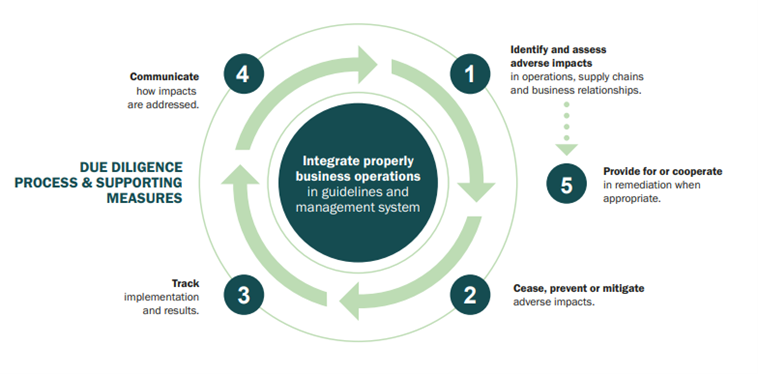
Moelven follows the OECD Due Diligence Guidance for Responsible Business Conduct. Moelven’s work on responsibility and transparency in the supply chain is based on the OECD’s Due Diligence Guidance for Responsible Business Conduct. The steps of the process are illustrated in the diagram.
Integrating Responsible Business Conduct into Policies and Management Systems
Moelven’s Code of Conduct and Sustainability Policy have been approved by the Group Board and serve as the highest-level governing documents guiding all group companies’ efforts towards responsible business conduct. The Group Management has also approved Moelven’s Supplier Code of Conduct, which is based on the ethical guidelines approved by the Group Board.
A Group-wide procedure for remediation of adverse impacts, including follow-up to ensure that remediation measures are effective over time, is currently under development. The procedures were not finalised as at 31 December 2025 but are expected to be rolled out during 2026.
Work is also ongoing to evaluate and, if necessary, update the Group’s procedures to ensure that suppliers do not procure goods, components, or services in violation of applicable sanctions regulations.
The Group has central functions that either have full responsibility for procurement or act in a coordinating role across the Group. These include:
- Raw Material Supply
Timber procurement is Moelven’s largest procurement category. All timber purchases for timber-consuming units in the Timber and Wood divisions are centralised through wholly owned subsidiaries: Moelven Virke AS in Norway and Moelven Skog AB in Sweden. Certifications like FSC® Chain-of-Custody or PEFC Chain-of-Custody are key to ensuring traceability in the supply chain. All timber purchased by Moelven must be controlled according to these certification standards. Moelven’s multisite certificates: FSC® C113012, PEFC/03-34-03. -
Central Coordination Group for Transport
Transport services are Moelven’s second-largest procurement category. Moelven has established a central coordination group for transport. The group’s mandate includes establishing overall frameworks for transport operations, including health and safety procedures (HSE), the Code of Conduct, and sustainability criteria. - Group Procurement Steering Committee
Main responsibilities include group-level procurement and the establishment of group-wide procurement agreements. Using group contracts provides a stronger foundation for due diligence and support measures. Each group-level contract must have a designated contract manager, and a representative from the Steering Committee must always participate in contract negotiations. As of June 2024, the requirements for responsible business conduct and transparency (as outlined in the Supplier Code of Conduct) are part of the decision criteria for signing new contracts.
In addition to overarching policies and central functions, certain subsidiaries have their own more specific policies and procedures depending on their business area. Examples include:
- Own certifications, quality management systems, or product certifications
For wood-based products, FSC® Chain-of-Custody or PEFC Chain-of-Custody certifications are especially important. For more information about Moelven’s certifications and product documentation see here. - Certified Suppliers
Several of the Group’s suppliers hold certifications that include aspects of responsible business conduct.
Identifying and Assessing Negative Impacts in Operations, the Supply Chain, and Business Relationships
Moelven works systematically to identify and assess the risk of adverse impacts on human rights and decent working conditions in its own operations, supply chain, and other business relationships, in line with the Norwegian Transparency Act and the OECD Guidelines for Multinational Enterprises and their due diligence framework.
Within Moelven’s own operations, the risk of adverse impacts is assessed as low. Moelven Industrier ASA and the Group companies in Norway and Sweden are subject to legislation that safeguards occupational health and safety, working conditions, and other employee rights. Moelven has established arrangements for structured cooperation with employee representatives and trade unions, as well as internal control procedures to monitor compliance with applicable laws and internal policies. An anonymous employee survey is conducted annually across the entire Group, including questions related to working conditions, harassment, and inappropriate behaviour. The survey response rate was 78% in 2025. Procedures are in place to ensure systematic follow-up of the survey results.
To perform effective and comprehensive due diligence assessments, it has been necessary to spend time mapping existing control routines already in place across the Group’s various subsidiaries. To avoid duplicate work, Moelven’s approach is to utilize existing routines and certification schemes wherever possible, supplementing these at the group level to ensure completeness.
In 2024, the work on categorising the supplier portfolio by geographical location, industry, and type of product or service was further developed. The due diligence efforts in the value chain in 2025 build on the methodology and experience established in 2024, where suppliers and business relationships were mapped and risk-assessed based on the following sources:
arbeidstilsynet.no, regjeringen.no, anskaffelser.no, and arbeidslivet.no.
The risk assessment of the different supplier categories, together with an overview of which categories are only to a limited extent covered by existing certification schemes that include human rights and labour rights as components, formed the basis for selecting supplier categories for supplier-level due diligence assessments. In addition, all Group-wide and divisional agreements were included.
- Transport Providers
Especially relevant for exports in the Timber and Wood divisions, where foreign transport companies are often used for return haul capacity. For domestic timber transport and Scandinavian operations, Moelven uses fewer partners, many of which are affiliated through ownership, and hold relevant quality/environmental certifications, indicating lower risk. Noted risks: Challenging working conditions, high rates of sickness absence and accidents, pressure, irregular hours, and illegal employment conditions for foreign workers. - Temporary workers and contracted cleaning services
This applies to all types of temporary workers and contracted services, but is especially relevant within the Building Systems division and cleaning services in general. The risks associated with hired labour include increased vulnerability to social dumping and labor market violations, particularly in the cleaning and construction sectors where unskilled labour is common. Low startup costs for new companies, unusual employment arrangements, and the use of foreign labour with poor pay and working conditions contribute to a heightened risk of exploitation and social dumping. - Workwear
The Group purchases large volumes of workwear, protective gear, and footwear annually, much of which is produced in regions with higher supply chain risks. Within the supply chain, including the extraction of raw materials and production, there is a risk of child labour, forced labour, lack of rights to organise, and poor working conditions, especially concerning health and safety. - Group- and division-level agreements
The group has several group- and division-level agreements with suppliers. It is fundamental from Moelven's side that these suppliers are aware of and actively work to meet the standards Moelven sets for ethical and responsible business practices.
Based on this, 321 suppliers were selected for a structured supplier survey, with priority given to suppliers in high-risk sectors, including transport, temporary labour/staffing, cleaning services, and workwear.
In 2025, the scope of the due diligence assessments was significantly expanded. Overall, the risk assessments now cover more than 80% of total procurement. Purchases of FSC®- or PEFC-certified timber and wood products have been excluded, as these are considered low risk based on existing certification schemes.
The mapping shows that more than 90% of Moelven Group’s suppliers operate in countries classified as low risk in recognised international country risk assessments. These suppliers account for 96% of our total procurement volume. Country risk is assessed using external indices measuring factors such as working conditions, human rights, corruption, and environmental conditions, and constitutes a key criterion in our initial supplier screening.
Based on the expanded analysis, additional suppliers were identified as having an elevated risk of adverse impacts, either due to country risk, sector risk, or limited available documentation on management systems and practices. These suppliers have therefore been prioritised for further follow-up through the collection of more detailed information and the assessment of potential risk mitigation measures.
Going forward, Moelven will continue to address identified risks in collaboration with suppliers and business partners, with the aim of preventing and reducing adverse impacts. The Group will also work to improve its due diligence processes and data foundation, including through the increased use of digital solutions and relevant external data sources.
Stop, prevent, or reduce negative impact
No cases of negative impact were identified in the period from 1 January 2025, to 31 December 2025. The work to establish a governance system for controlling the Group’s entire supply chain will continue throughout 2026.
Moelven’s established whistleblowing channel is used for any complaints related to the Group’s work with the Transparency Act:
- Email: varsling@moelven.com
- Anonymous reporting: whistleblowing.moelven
Requests for information under the Transparency Act’s duty to inform:
- Email: apenhetsloven@moelven.com
Monitor implementation and results
The Group’s procedures for due diligence, as well as implemented measures, are evaluated annually to ensure continuous improvement. Emphasis is placed on ensuring that Group-wide procedures, in combination with entity-level procedures and certification schemes, collectively provide a satisfactory level of due diligence. Responsibility for this work lies with the Group’s sustainability function in collaboration with Group procurement.
Results from the due diligence assessments are communicated internally to the department responsible for the relevant supplier category or supplier. Communication to external stakeholders takes place through the annual report required by the Transparency Act. Any identified cases of adverse impacts that violate requirements in certification schemes or similar will be communicated within the value chain to parties that are or may be affected.
Communication
Moelven’s website is the main communication channel for information about Moelven Group and its subsidiaries’ work related to the Transparency Act.
The statement prepared in accordance with the Transparency Act’s requirements for public disclosure of information by all group companies has been signed by the boards of all Norwegian Group companies covered by the Act, and can be found at: www.moelven.no/apenhetsloven.
Share article:


